10th October 2025, Humboldt University Berlin, Institute of Asian and African Studies
In this hybrid ReCrea[1] workshop funded by Circle U.[2], we looked at the significance of festivals as major events that foster the distribution and visibility of arts and crafts in African and Afrodiasporic contexts. The one-day workshop was designed as a meeting place between academics and practitioners in the field and will encompass roundtable interviews with festival makers and artists as well as analytical papers by scholars from fields such as media studies, literary and cultural studies, as well as economics, anthropology and sociology. Read below the full report by Prof. Susanne Gehrmann.
The Significance of Festivals for African & Afrodiasporic Creative Economies
On October 10th, the ReCrEA project dedicated a one-day workshop to the issue of festivals as an important motor for economic gain, creative inputs and not least audience – artist interaction regarding different branches of African arts and cultures. The workshop was organized in hybrid mode, taking place at the institute of Asian and African studies of HU-Berlin and via Zoom conference for participants who could not make to Berlin.
We started with the welcoming address of the three project leaders, setting up the agenda for the day. The scope of the workshop explicitly included Africa – Diaspora relations and beyond contributions on Nigeria and South Africa who had already been prominent in earlier activities also contributions on the DRCs creative economy. As we explained, the workshop was also designed as a meeting space between academics and practitioners, therefore including roundtable sessions with festival makers.
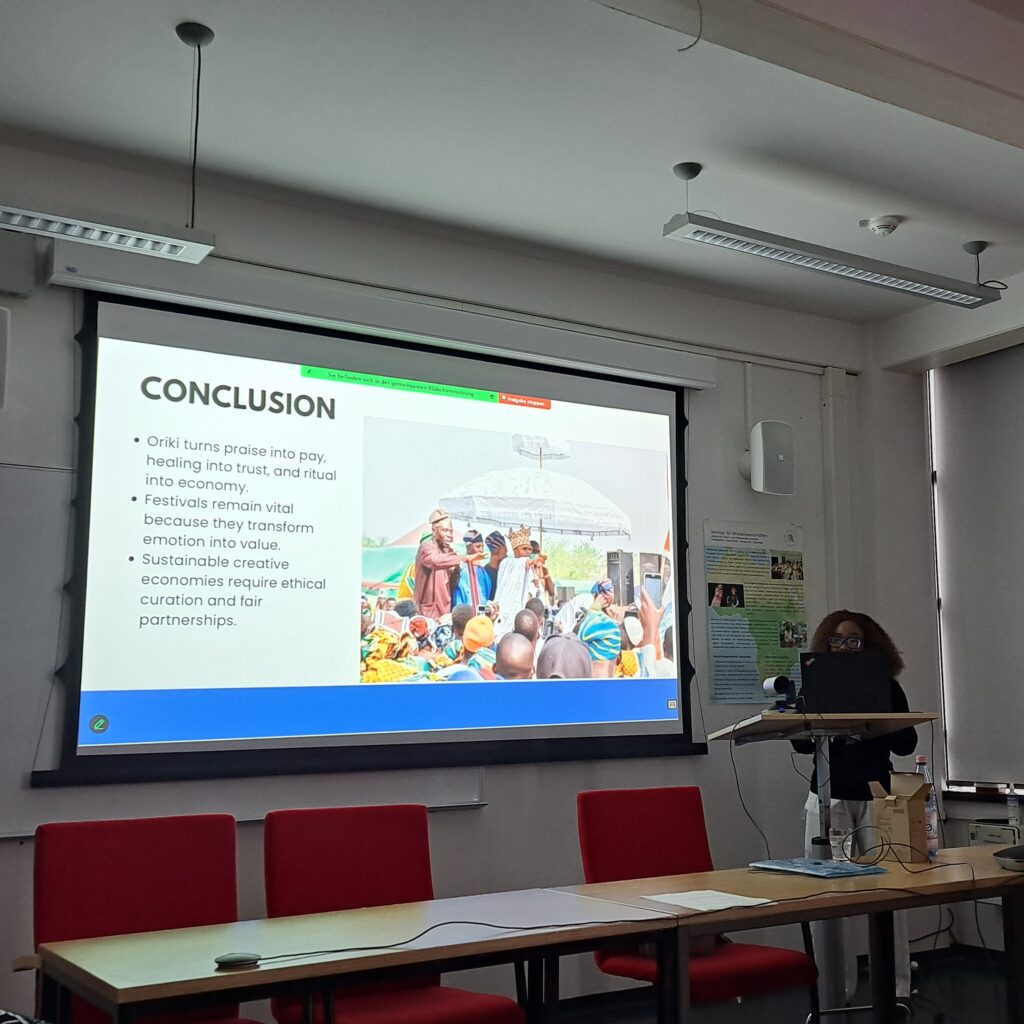
Toluwalope Orotoye from the department of English at the University of Ibadan, and currently a visiting postdoctoral researcher at HU-Berlin presented a paper on Oríkì (a form of praise poetry in Yoruba) as an affective infrastructure in Nigeria’s Festival Economy. As she exposed, Oríkì are a highly coded medium of communication that establishes and maintains social and economic ties between artists and festival attendants, particularly in the realm of patronage. Poetry, therefore, can be considered an important means to stabilize the cultural economy of the prominent music, theatre and religious festivals that are so important in South-West Nigeria.
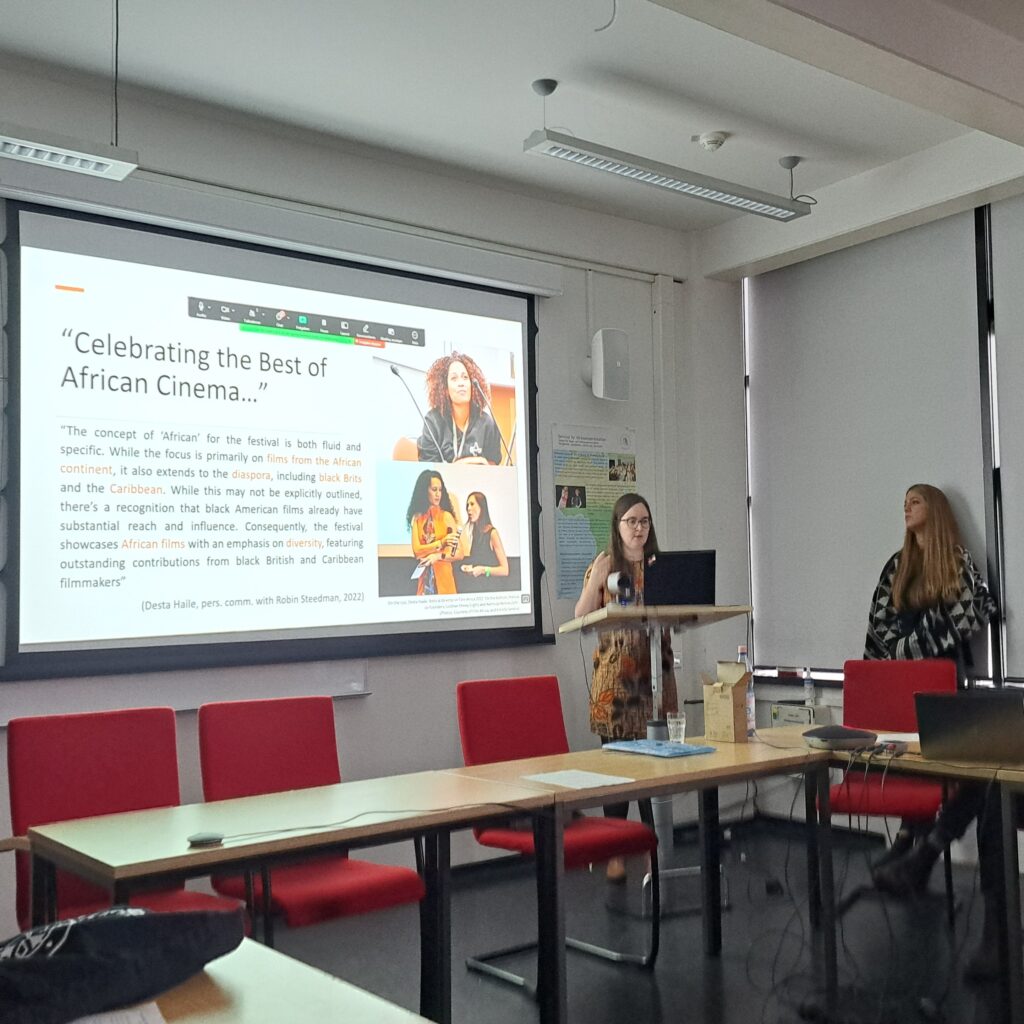
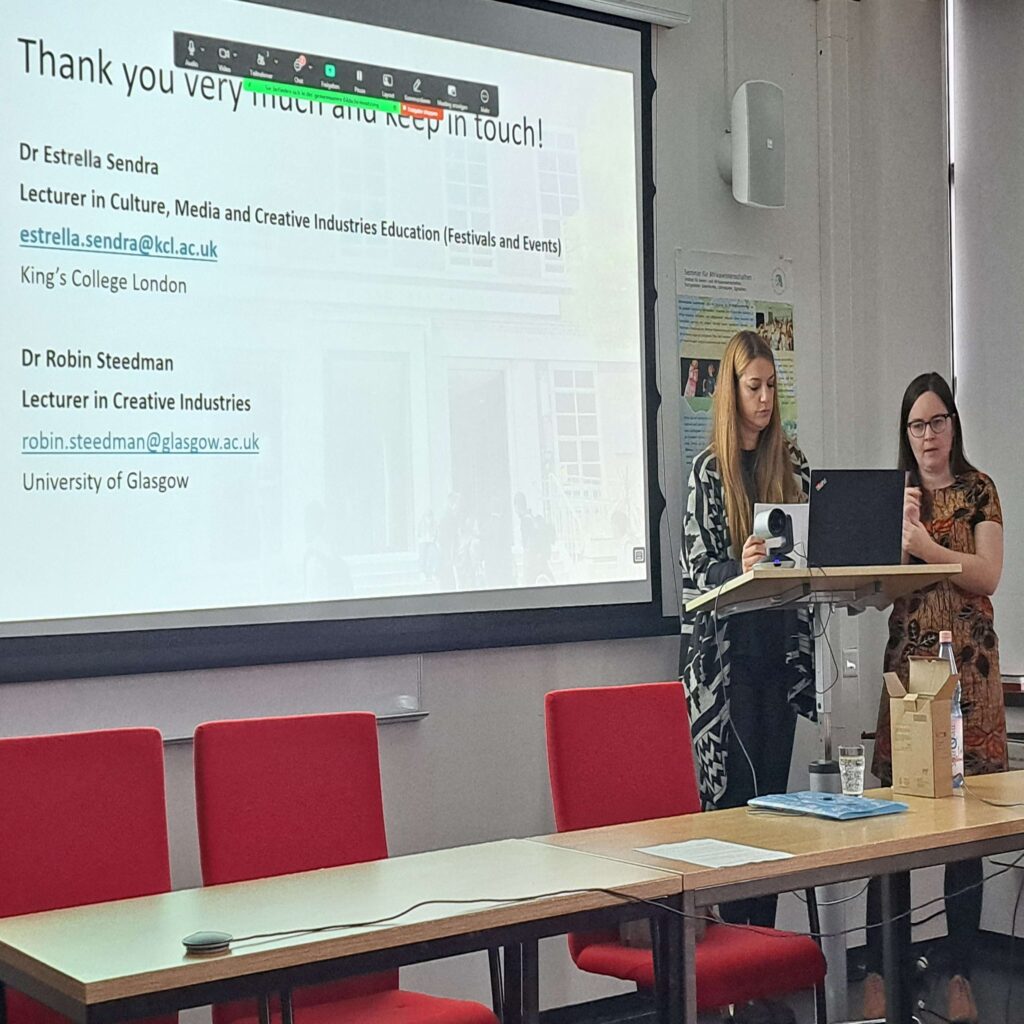
Estrella Sendra from the department of creative economy at King’s College, London and Robin Steedman from the school of culture and creative art at the University of Glasgow presented a joint paper on “Film Africa” London, the leading African film festival in the UK. Based on participatory observation, diaspora-continent interaction in curating the festivals and its immense contribution to the international circulation of African cinemas were pointed out.
The morning session, with all speakers present in Berlin, was rounded up by a roundtable format with Stefanie Hirsbrunner, founder and director of the African Book Festival Berlin, and South African writer Niq Mhlongo, co-founder of the Gauteng International Book Festival and now a collaborator of the Berlin festival who were interviewed by Susanne Gehrmann. Their elaborate sharing of experience in curating festivals in South African and diaspora contexts in Berlin, especially with literature as an art that strongly negotiates identity politics, were in many respects eye-opening for the academics trying to understand the dynamics behind festival making.
After lunch break, presentations were virtual, with a group of about 10 researchers present in the institute’s local and a virtual audience of about fifteen people. Fadekemi Olawoye, postdoc in media studies at Goethe Universität Frankfurt, presented a paper on fashion in the context of the Nigerian Movie Awards Events. The Nollywood film industry with its glamourous festival events is thus stimulating the creativity of Nigerian fashion designers – and vice versa. Both cinema and fashion are incredibly important sectors of Nigeria’s growing creative economy.
Fiona Drummond, Jen Snowball, Nkululeko Sibanda and Mawuko Gyan from the department of economics at Rhodes University, Makhanda in South Africa presented a collaborative case study on the question of sustainability with regard to South Africa’s National Arts Festival. Economic, cultural, social, environmental, and political aspects were analysed, proving the variety and the complexity of interests and engagements at play in such a huge state driven festival.
The next contribution came in in video format. Ramcy Kabuya, a postdoctoral researcher at the department of African studies at HU-Berlin spoke about his recent field research in Lubumbashi, the DRC’s second largest city, but also at the EOTO literature festival in Berlin. He juxtaposed formats and functions of literary events, dissemination of literary texts and audience-writer interactions in the DRC and in the diaspora. Despite the contrast between those two spaces, the sharpening of social and political consciousness plays a role in both.
We rounded the day off with a second roundtable-interview session. Tshoper Kabambi, filmmaker and director of the Festival International du Cinéma de Kinshasa, was interviewed by Susanne Gehrmann testified on the internationally not yet well known, but emerging Congolese film industry that operates under unfavourable economic and social circumstances. The significant role of the Kinshasa festival, seconded also by a second cinema festival in Goma, in building up an independent, economically sustainable film scene that primarily caters for Congolese audiences was underlined.
The interdisciplinary character of the workshop that brought scholars from economics, African studies, media studies, literary studies ad not least practitioners with first-hand experience of festival making together, contributed to the lively discussions we had throughout the day.
[1] A collaborative format linking Roberta Comunian, King’s College London, Teke Jacob Ngomba, Aarhus University and Susanne Gehrmann, HU-Berlin.
[2] A seed funding programme that encourages intra-European collaborations.